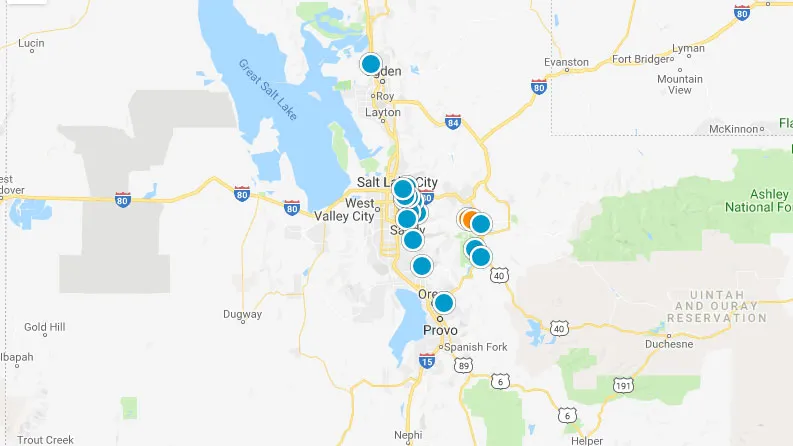
Common questions about buying and owning property in Utah County. See current Utah County listings.
What cities and towns are in Utah County?
Utah County's municipalities include Alpine, American Fork, Bluffdale, Cedar Fort, Cedar Hills, Draper, Eagle Mountain, Elk Ridge, Fairfield, Genola, Goshen, Highland, Lehi, Lindon, Mapleton, Orem, Payson, Pleasant Grove, Provo, Salem, Santaquin, Saratoga Springs, Spanish Fork, Springville, Vineyard and Woodland Hills. Draper and Bluffdale reach in from Salt Lake County. Each city sets its own zoning, permits and fees.
How big is Utah County, how fast is it growing, and where can I find market numbers?
Utah County had an estimated 765,515 residents on July 1, 2025 and added 15,914 people in 2025, the most of any Utah county and about 36% of the state's growth, according to the Gardner Institute. The Census Bureau counts about 15.2% growth between April 2020 and July 2025 and 7,202 building permits in 2025. Utah County has the largest average household of the six counties on this site, at 3.39 people. See the county market report below for trends. For a specific city or neighborhood, ask a professional at Utah Property Finder.
How does the primary residence exemption work in Utah County?
A qualifying Utah home is taxed on 55% of its market value. The home must be a primary residence for at least 183 consecutive days in a year. If your mailing address differs from the property's physical address, state law requires you to submit a residential property declaration, and if you get a letter from the Utah County Assessor you must respond within 90 days or the exemption can be removed. The assessor offers an online declaration and a PT-23 application, which is also used for a part-year residence. Starting January 1, 2027, Utah law (S.B. 238, passed in 2026) requires an owner to file a new application with the county when an ownership interest in the home changes, so a buyer should not assume the seller's exemption carries over. If a home may be part second home, part rental, ask a professional at Utah Property Finder to walk through the tax effect.
How are homes valued for property tax in Utah County, and how do I appeal?
The assessor values property as of January 1, and valuation notices go out near the end of July. You can appeal your market value to the Utah County Board of Equalization by September 15. Online and email appeals are due by 11:59 p.m. that day, mailed appeals must be postmarked by then, and in-person filings must arrive before 5 p.m. A late appeal can be filed until March 31 of the following year, but the board must accept it first. The appeal is about value, not the tax bill, and should include evidence such as comparable sales or an appraisal. For a view on whether a valuation looks high or low against recent sales, ask a professional at Utah Property Finder.
Which school districts serve Utah County, and what is changing?
Utah County currently has Alpine School District, Provo City School District and Nebo School District. Alpine, Utah's largest district, is dividing: on July 1, 2027 it will be replaced by Aspen Peaks (Alpine, American Fork, Cedar Hills, Highland, Lehi and the Utah County part of Draper), Lake Mountain (Saratoga Springs, Eagle Mountain, Fairfield and Cedar Fort) and Timpanogos (Orem, Lindon, Pleasant Grove and Vineyard). The 2026-27 school year still runs under Alpine. Provo City School District and Nebo School District are separate districts and are not part of the split. A new district does not by itself change a child's school, and each new district will set its own tax rate, so confirm the current school and district with the district for a specific address.
What are the main roads, transit and commutes in Utah County?
I-15 is the main route, running through Lehi, American Fork, Orem, Provo and Spanish Fork, and UDOT's I-15 CORE project added two lanes in each direction between Lehi and Spanish Fork in 2012. UTA's FrontRunner commuter rail stops in Lehi, American Fork, Vineyard, Orem and Provo and runs north through Salt Lake County to Ogden. On the west side, UDOT opened the first four-mile Utah County section of Mountain View Corridor in December 2025, part of a planned 35-mile route to I-80. The Census Bureau puts the average commute for Utah County workers at 22.6 minutes (2020-2024). Drive times vary a lot by city and time of day, so test the commute at the hours you would drive.
How do water and power work in Utah County?
Utah County's cities set up their own utilities, so providers differ from one address to the next. The state lists municipal electric utilities in Lehi, Payson, Provo, Salem, Spanish Fork and Springville, a South Utah Valley Electric Service District in part of the south county, and Rocky Mountain Power serves most other areas. Enbridge Gas Utah serves roughly 90% of Utah households. Many cities also run a separate secondary or pressurized irrigation system for lawns. Water supply is tighter on the fast-growing west side: Eagle Mountain's 2026 water element says the city lacks enough supply for the homes already approved and is pursuing new groundwater and reuse. Ask your city about the provider, secondary water and any watering limits.
What should I know about buying new construction in Utah County?
Utah County issued 7,202 building permits in 2025, the most of the six counties on this site, so new homes are being added all over the county, and this site has a Utah County New Construction page. Beyond the price, new homes can carry one-time impact fees that cities and districts charge for water, sewer, roads, parks and public safety; the amounts vary by city. Before you buy in a fast-growing area, ask about the water supply, secondary irrigation and when schools and roads will catch up. In Utah the assessor values a home under construction by how complete it was on January 1, so the first tax bill may not reflect the finished home. Check the builder's license on the state's license lookup. A professional at Utah Property Finder can help you compare incentives, upgrades and contract terms.
Utah County new construction homes
Can I rent a Utah County home short term?
It depends on the city. Utah law lets cities require a license for short-term rentals but not penalize someone only for listing a home online. Provo requires a short-term rental license. Orem's city code currently prohibits short-term rentals, and its City Council was still working on a licensing policy as of October 2026, so rules there may change. Other cities have their own rules. A rental home does not get the primary residence exemption, and many HOAs ban short-term rentals. Confirm the rules for the exact address before you buy, and ask a professional at Utah Property Finder about the city's current policy.
What should I know about HOAs in Utah County?
Many Utah County neighborhoods have a homeowners association, and some communities layer a master association over smaller neighborhood associations. Newer master-planned neighborhoods and townhome communities often have master and sub-associations, and dues, rental limits and design rules differ widely. Utah law requires a seller to give the buyer the association's recorded governing documents before closing, associations must share a reserve analysis summary with owners each year, and associations must register with the state and renew every year. Ask for the budget, reserve analysis, meeting minutes, current dues, any special assessments, and any resale or transfer fee. A professional at Utah Property Finder can help you review those documents for a specific home.
Have a question we didn't answer? Reach out to a professional at Utah Property Finder. Browse Utah County listings.
Address Search
Search by Map